ClaveQ
Private beta · by invitation

Whitepapers

Three papers on cryptography in industrial networks

Written for the engineers who run plant networks and the people who secure them. Read them in this order: The Clock on when today's public-key encryption could fall, Beyond the Proxy on what a quantum-safe proxy leaves exposed, and Listen First on how to find out what your network carries without putting the process at risk. Each paper lists its sources in a table at the back.

Paper 1 · When

The Clock

When will a quantum computer break today's public-key encryption, and should industrial operators prepare now or wait?

After reading, you can run Mosca's test on your own systems and decide whether to start now or wait, knowing how binding each government date is.

At a glance

  • A leading expert survey suggests a quantum computer that could break today's public-key encryption is more likely than not by about 2040.
  • For data or keys that must stay safe for years, protection time plus migration time already runs past that point.
  • Start finding where your systems rely on this encryption now: the UK's first target date, 2028, is guidance, and every later step depends on it.

Contents

  1. When will a quantum computer break today's public-key encryption?
  2. What a quantum computer would break, and when the harm begins
  3. Mosca's test: is there enough time to finish?
  4. Why industrial systems need more time to migrate
  5. Government target dates, and how binding each one is
  6. Prepare now or wait? A decision table for operators
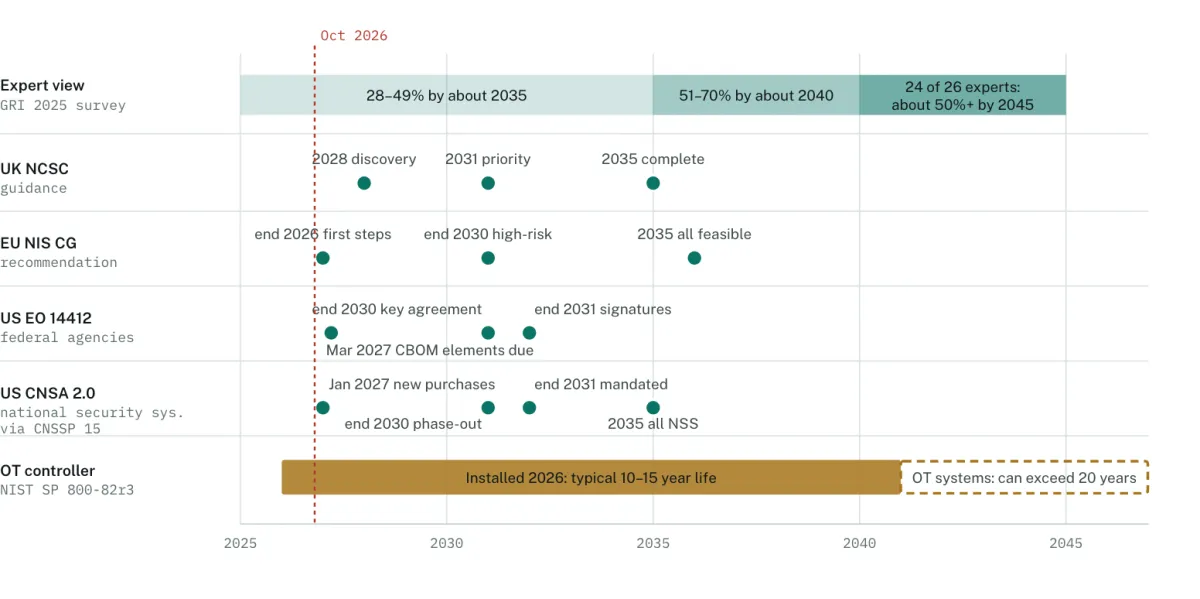
Timeline from 2025 to 2047. Top row: the Global Risk Institute expert survey, 28 to 49 per cent by about 2035, 51 to 70 per cent by about 2040. Below it, target dates from the UK NCSC (2028, 2031, 2035), the EU NIS Cooperation Group, US Executive Order 14412 and CNSA 2.0, mostly between 2027 and 2035. Bottom row: a controller installed in 2026 with a typical 10 to 15 year life, and OT systems that can exceed 20 years.
Figure 1 from the paper: expert odds, government target dates and equipment life. Full size
Length
12 A4 pages, about 11 minutes
Figures
1, plus a decision table
Cites
12 sources, including NCSC, NIST, NSA, the White House, the EU NIS Cooperation Group and the Global Risk Institute survey
ClaveQ in it
Named only as publisher: title line, closing note and copyright
Accurate as of
October 2026
Request the PDF

Paper 2 · What a proxy misses

Beyond the Proxy

What a quantum-safe internet boundary leaves exposed

After reading, you can work out which of your traffic a quantum-safe proxy actually protects, and plan how to find the rest.

At a glance

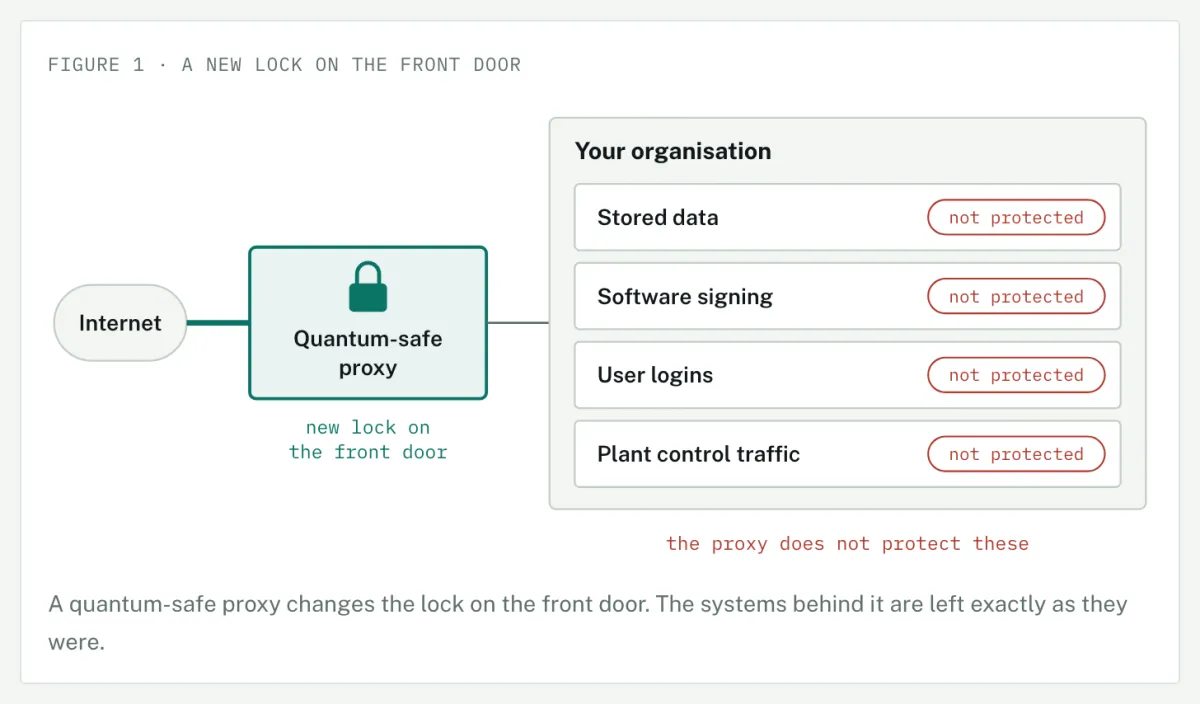
  • A quantum-safe proxy protects only traffic crossing the internet boundary.
  • Stored data, software signing, user logins and plant control traffic stay exposed.
  • Keep the proxy, and pair it with discovery so you can see what is left.

Contents

  1. Executive summary
  2. Attackers are already inside, and already copying traffic
  3. What a proxy protects, and what it leaves alone
  4. Discovery versus proxy remediation
  5. A staged migration plan
  6. Network discovery, and where ClaveQ Scan fits
  7. The regulatory backdrop
The internet connects to a quantum-safe proxy, labelled a new lock on the front door. Behind it, inside your organisation, stored data, software signing, user logins and plant control traffic are each marked not protected.
Figure 1 from the paper: a new lock on the front door. Full size
Length
18 A4 pages, about 18 minutes
Figures
4
Cites
31 sources, including joint CISA, NSA and FBI advisories, NCSC, CERT Polska, CERT-UA, ESET, Dragos and NIST
ClaveQ in it
Section 06 says where ClaveQ Scan fits and what it does not cover, with our bench test of Scan behind a commodity TAP; the paper ends with an invitation to the private beta
Accurate as of
October 2026
Request the PDF

Paper 3 · How to start

Listen First

A practical guide to starting OT security discovery

After reading, you can choose where to put a TAP or mirror port, and in what order, without sending a packet to a controller.

At a glance

  • Listen to the traffic already on the plant network before sending anything, because probing can upset older controllers.
  • With written approval, listen first where the office network meets the plant and in the control room; leave safety systems out.
  • Turn what you hear into a record of devices, connections and the encryption each uses, if any, and keep it current.

Contents

  1. Why discovery comes first
  2. Get permission and agree the scope
  3. Do no harm: listen before you probe
  4. Where to listen
  5. What to look for
  6. Turn findings into an inventory
  7. Keep the inventory current
  8. Tools to start with
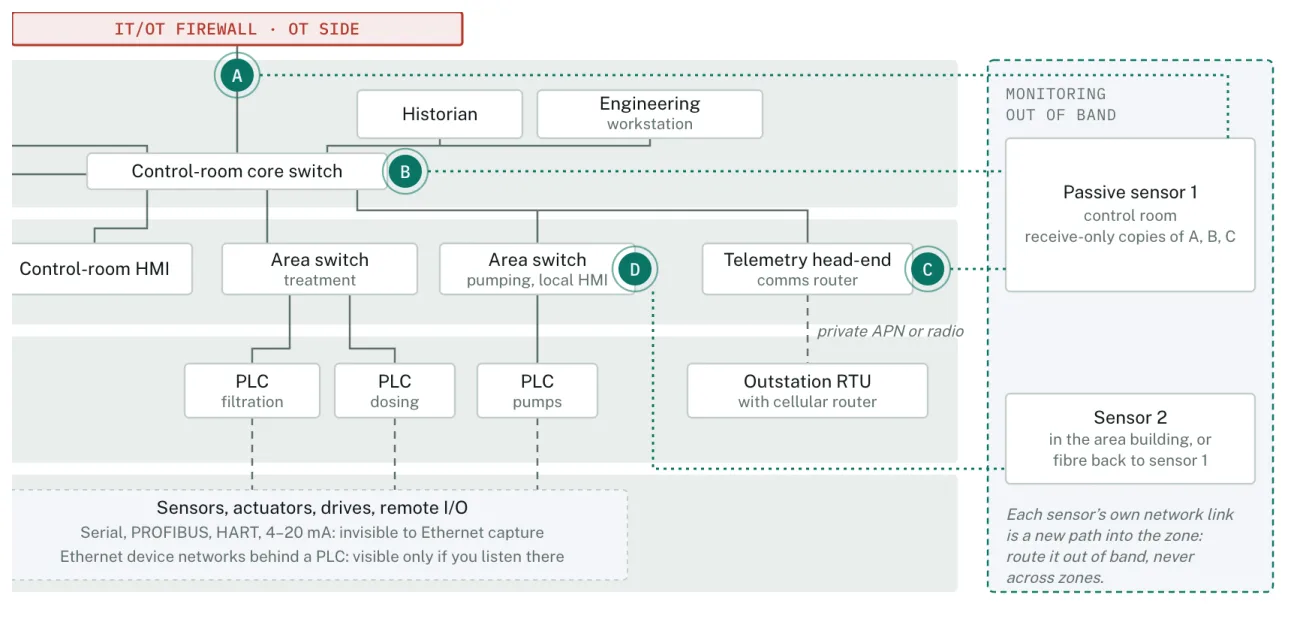
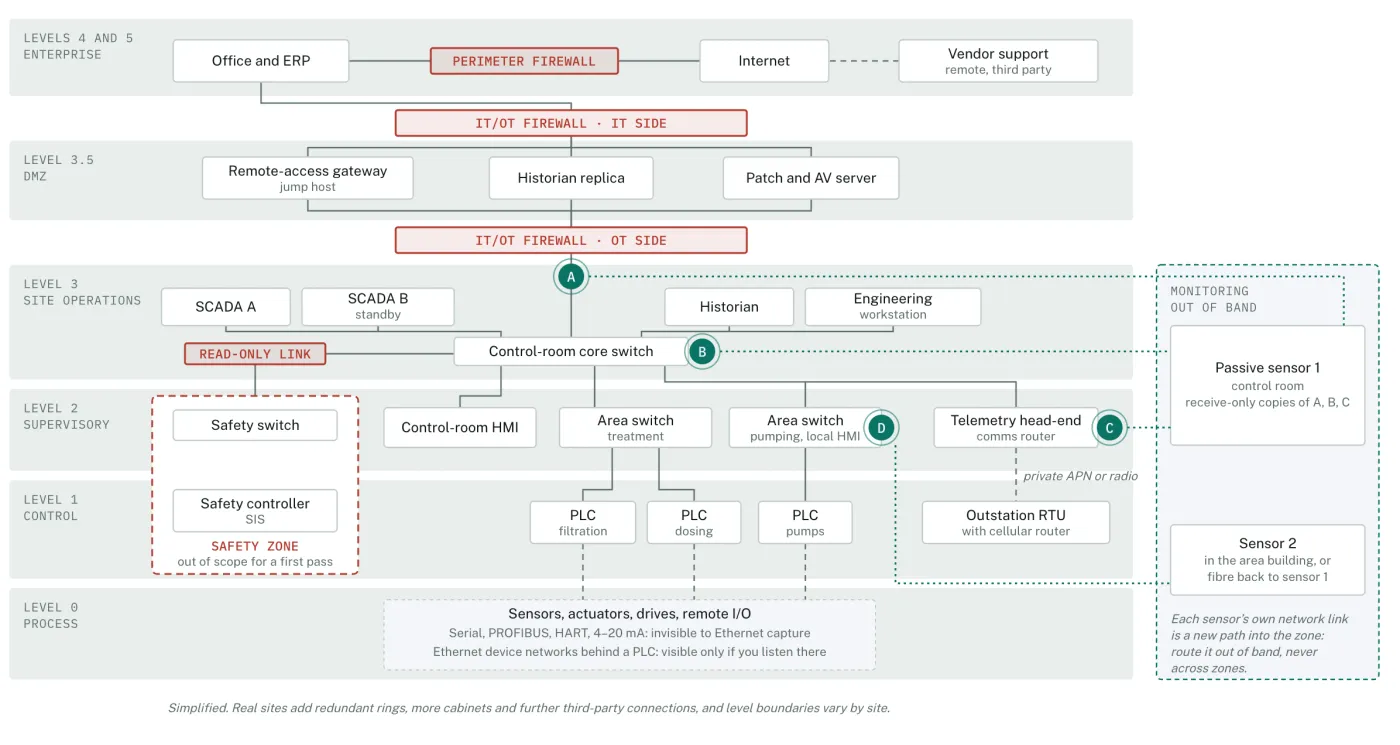
Close-up of the listening points on a typical site: A on the OT side of the IT/OT firewall, B at the control-room core switch, C at the telemetry head-end and D at an area switch. Dotted lines carry copies from A, B and C to sensor 1 in the control room and from D to sensor 2, both drawn in an out-of-band monitoring box, with the note that each sensor's own network connection must be routed out of band, never across zones.
Detail of Figure 1 from the paper: recommended listening points, in the order to add them. Full figure
Length
16 A4 pages, about 16 minutes
Figures
1
Cites
12 sources, including joint CISA and NCSC guidance, NIST SP 800-82, ISA/IEC 62443 and CERT Polska
ClaveQ in it
The tools chapter lists Zeek with CISA's ICSNPP parsers, Malcolm, Wireshark, Nozomi Networks Guardian, Claroty xDome and the Dragos Platform; ClaveQ Scan gets one paragraph, limits included
Accurate as of
October 2026
Request the PDF

Request the PDFs

The papers are free. This form tells us who asked for which one and gives you the links. Untick any you do not want.

Your PDFs

Background reading: What is a CBOM? Post-quantum migration for OT OT encryption